
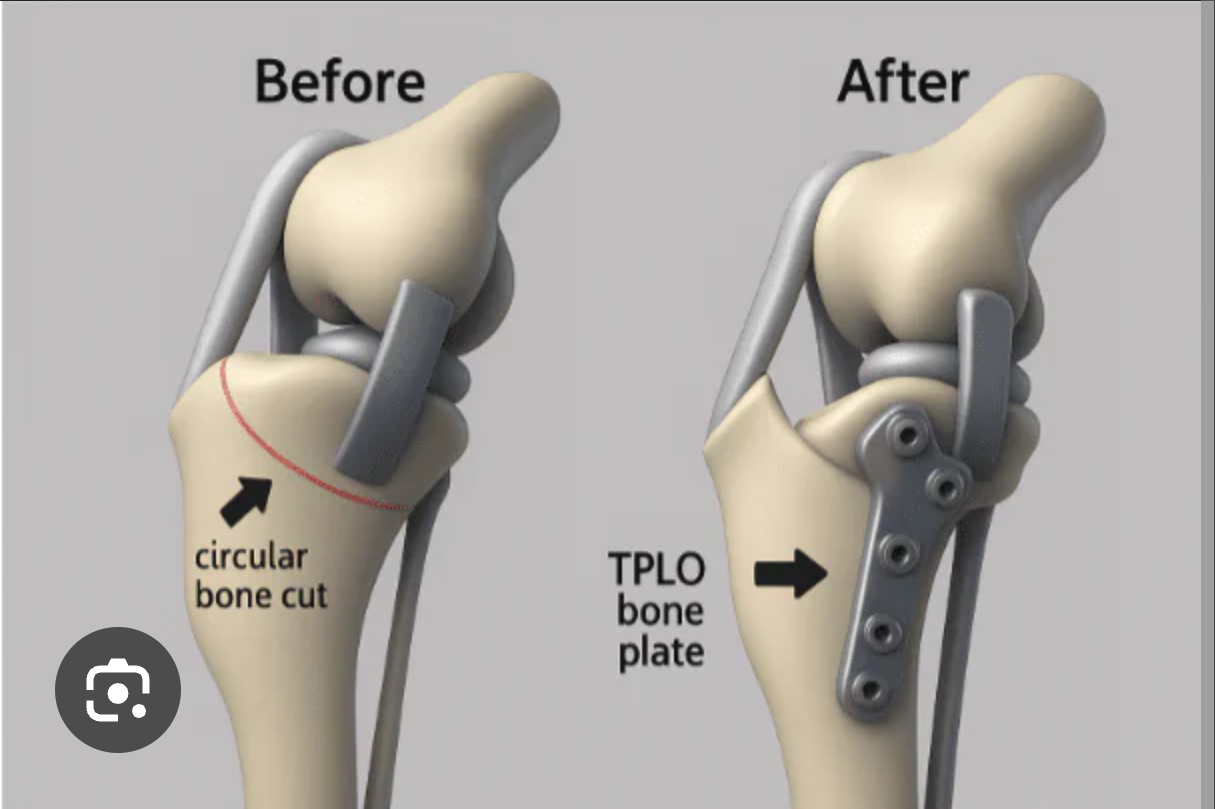
TPLO-M: A Dual-Purpose Solution for CCL and MPL in Dogs
TPLO-M is an innovative modification of the traditional Tibial Plateau Leveling Osteotomy (TPLO) designed to simultaneously address Cranial Cruciate Ligament (CCL) rupture and Medial Patellar Luxation (MPL) in dogs. By combining stabilization of the cranial cruciate ligament with controlled lateralization of the tibial tuberosity using a stack plate, the technique eliminates the need for separate corrective procedures. Clinical evaluation of 17 canine patients demonstrated excellent patellar stability, rapid return to weight-bearing, reduced operative time, lower implant inventory requirements, and favorable functional outcomes. TPLO-M represents a practical, economical, and biomechanically sound advancement in small animal orthopedic surgery.
Overview
Cranial Cruciate Ligament (CCL) rupture and Medial Patellar Luxation (MPL) are among the most common orthopedic disorders affecting the canine stifle joint. Managing both conditions simultaneously has traditionally required multiple corrective procedures, increasing surgical complexity, operative time, and implant requirements.
TPLO-M introduces an innovative modification to the conventional Tibial Plateau Leveling Osteotomy (TPLO), allowing both conditions to be addressed in a single surgical procedure while maintaining excellent biomechanical stability and improving overall patient recovery.
Background
Traditional TPLO effectively neutralizes cranial tibial thrust associated with CCL rupture but does not correct patellar maltracking caused by Medial Patellar Luxation. Conventional treatment therefore often combines TPLO with additional corrective osteotomies or tibial tuberosity transposition.
The TPLO-M technique was developed to overcome these limitations by integrating both corrections into one procedure through controlled lateralization of the distal tibial fragment.
Surgical Technique
The TPLO-M procedure follows a standard TPLO osteotomy before introducing a specially designed stack plate beneath the distal portion of the TPLO plate.
This modification allows controlled lateral movement of the distal tibial fragment, effectively restoring quadriceps alignment and patellar tracking while maintaining the desired tibial plateau angle.
Key advantages include:
Single surgical procedure for concurrent CCL rupture and MPL
Reduced implant inventory
Lower overall surgical costs
Shorter operative time
Stable fixation
Improved biomechanical alignment
Clinical Results
The retrospective study evaluated 17 canine patients presenting with concurrent Cranial Cruciate Ligament rupture and Grade II–III Medial Patellar Luxation.
Clinical outcomes demonstrated:
Excellent patellar stability
Approximately 95% of dogs returned to full weight bearing within six weeks
Reduced surgical time compared with performing separate TPLO and MPL procedures
Minimal postoperative complications
Reliable implant stability
These findings support TPLO-M as a safe and effective solution for combined orthopedic conditions.
Advantages of TPLO-M
Compared with traditional TPLO techniques, TPLO-M offers several important benefits:
Simultaneous correction of CCL rupture and MPL
Reduced surgical morbidity
Preservation of bone stock
Smaller surgical exposure
Improved patellar alignment
Lower implant inventory requirements
Faster recovery potential
Conclusion
TPLO-M represents an important advancement in veterinary orthopedic surgery by providing a practical, economical, and biomechanically sound solution for dogs suffering from concurrent Cranial Cruciate Ligament rupture and Medial Patellar Luxation.
Early clinical outcomes demonstrate excellent functional recovery, stable implant fixation, improved patellar tracking, and reduced surgical complexity, making TPLO-M a promising technique for modern small animal orthopedic practice.