
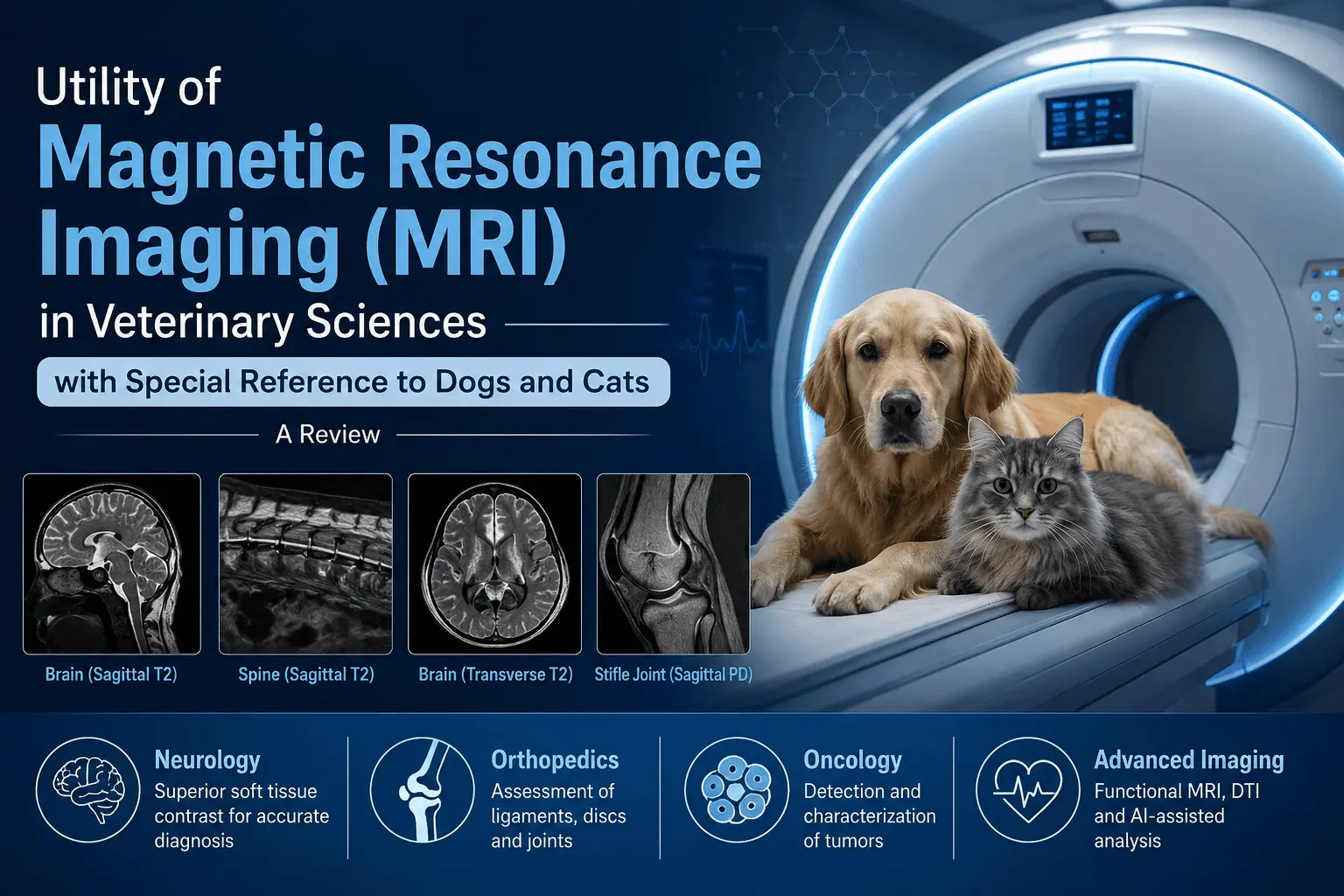
Utility of Magnetic Resonance Imaging in Veterinary Sciences with Special Reference to Dogs and Cats: A Review
Magnetic resonance imaging (MRI) has become the gold standard for soft tissue and neurological imaging in companion animals. This review discusses the principles of MRI, its comparative advantages over other imaging modalities, and its clinical applications in dogs and cats, with a focus on neurology, orthopedics, oncology, internal medicine, and future advancements such as artificial intelligence and functional imaging.
Overview
Magnetic resonance imaging (MRI) is one of the most advanced diagnostic imaging modalities available in veterinary medicine. Owing to its exceptional soft tissue contrast and multiplanar imaging capabilities, MRI has become the preferred technique for evaluating neurological, musculoskeletal, and oncological conditions in dogs and cats.
This review explores the principles of MRI, compares its advantages with radiography, computed tomography (CT), and ultrasonography, and discusses its expanding role in veterinary diagnostics and surgical planning. The article also reviews species-specific considerations, current limitations, recent technological advancements, and future directions including artificial intelligence-assisted imaging.
Highlights
Fundamentals and physics of magnetic resonance imaging.
Comparison of MRI with CT, radiography and ultrasonography.
Applications in neurology, orthopedics, oncology and internal medicine.
MRI findings in brain tumors, epilepsy, IVDD and spinal disorders.
Species-specific MRI considerations in dogs and cats.
Emerging technologies including functional MRI, diffusion tensor imaging and AI-assisted diagnostics.
Clinical Significance
MRI continues to represent the gold standard for soft tissue imaging in companion animal practice. As accessibility improves and newer technologies become integrated into routine practice, MRI will continue to play an increasingly important role in accurate diagnosis, treatment planning, prognosis, and precision veterinary medicine.
Corresponding Author
Dr. Kunal Dev Sharma, Dr. Tarun Nar Singh