
Distal Femur Fracture Repair
A detailed look into a successful treatment at MaxPetZ.
Signalment and History
CHUTKI, a juvenile INDIE female (12.0 kg), presented with acute left hindlimb lameness after an injury. On initial exam she was walking on three limbs with pain on palpation of the left hindlimb; distal femoral injury was suspected.
Clinical Examination
Patient was active and alert. Left hindlimb painful on palpation; pedal responses present and FUD (food, urine, defecation) clinically normal on exam.
"MRI + CT + 3D planning for safer surgery."
Diagnostic Imaging
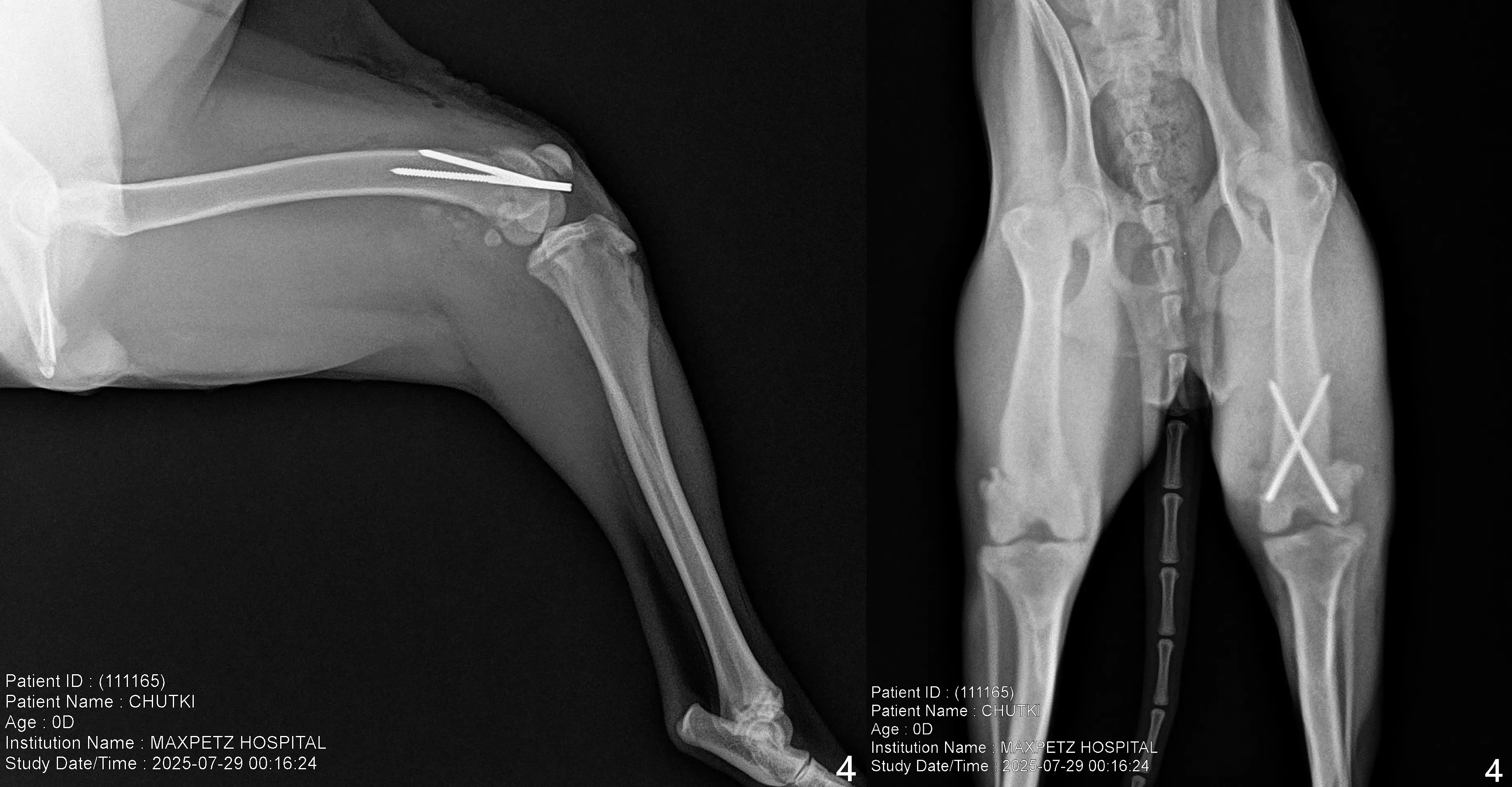
Serial orthogonal radiographs were performed (requisitions 438622, 438747, 438750 and later 444486). Imaging confirmed a distal femoral fracture of the left hindlimb. X-ray reports and attachments are included in the clinical record.
Surgical Procedure
On 29 Jul 2025, distal femur fracture repair was performed under gaseous/general anesthesia by Dr. Kanika Singh. Cross-pinning was used to stabilise the distal femoral fracture (construct appropriate for physeal/distal femoral fractures in juvenile patients). Skin was closed with non-absorbable suture material. OT charges and consumables were recorded on the procedure date.
Perioperative Medications & Intra-op Notes
Perioperative records show routine anesthetic induction/maintenance and uneventful intra-op course. Post-op injectable medications and immediate monitoring were provided as per protocol.
Postoperative Management
Prescribed post-op medications:
Cephavet / Lisen 300 mg — 1 tab twice daily for 7 days
Firotail 57 mg — 1 tab once daily for 5 days
Chymoral Forte — 1 tab twice daily for 10 days
Merical Brisket DS — 1 tab twice daily for 20 days
ET LIV syrup — 5 ml orally twice daily for 15 days
Post-op instructions:
E-collar mandatory 24×7 for 10 days
Sutures to be removed after 7–10 days
Daily dressing; restricted walking for 7 days
Review after 3 days (prior appointment recommended)
Postoperative Events & Follow-up
31 Jul 2025 — single seizure episode with involuntary paddling and frothing; settled after the event. Immediate advice given (midazolam nasal spray or rectal diazepam) and gabapentin recommended if seizures recur.
09 Aug 2025 — presented for suture removal. Owner reported intermittent knuckling while passing urine; suture removal performed and oral meds continued.
16–17 Aug 2025 — follow-up radiographs performed; X-ray report attached on 17 Aug 2025.
Discussion
Distal femoral fractures in juvenile patients often involve the physis or metaphysis and must be treated to restore alignment and protect future limb growth. Cross-pinning provides rotational and axial stability with minimal physeal disturbance when used for selected distal femoral fractures. Seizure occurrence was an isolated event per notes and managed per protocol.
Conclusion
This case documents distal femur fracture repair in CHUTKI using cross-pinning with appropriate perioperative care, suture removal, and radiographic follow-up. (Outcome left blank pending final long-term outcome.)
Treatment Timeline
26 Jul 2025
Initial Presentation
Presented with left hindlimb lameness; radiographs indicated distal femoral fracture. Surgical correction advised.
27 Jul 2025
Pre-op Diagnostics
CBC, LFT, KFT and radiographs performed (requisition 438747/438750). AFAST/TFAST performed as needed.
29 Jul 2025
Surgery
Distal femur fracture repair under gaseous anesthesia by Dr. Kanika Singh. Cross-pinning used for stabilization; skin closed with non-absorbable sutures.
29 Jul 2025 – 03 Aug 2025
Early Post-op Care
Post-op medications prescribed, E-collar and restricted walking advised, daily dressing and wound care instructed; review planned at 3 days.
31 Jul 2025
Seizure Event & Management
Single seizure episode with involuntary paddling and frothing; emergency measures advised (midazolam nasal spray/rectal diazepam). Gabapentin recommended if seizures recur.
09 Aug 2025
Suture Removal & Follow-up
Presented for suture removal; knuckling while passing urine noted; suture removal performed and oral meds continued.
16–17 Aug 2025
Radiographic Follow-up
Radiographs performed and report attached; ongoing monitoring of healing and limb function planned.
Your Pet Deserves Specialist Care
If you're concerned about your pet's health, our team is ready to provide the advanced care and compassion they need.